

Заходи УГА
October 7, 2025
Мигдалевий альянс України та Іспанії.
Based on the conclusions of Spanish practicing gardeners, with whom Ukrainian specialists spoke during their visit to Spain, the key to a successful almond business is self-fertile Spanish varieties on the GF-677 rootstock.
ALMOND ALLIANCE OF UKRAINE AND SPAIN.
Since 2019, specialists of the Ukrainian Nut Association have been studying the possibilities of different almond varieties and, based on several years of research into the cultivation of different almond varieties, Spanish varieties have demonstrated good indicators of cultivation and productivity, winter hardiness and frost resistance in different climatic zones of Ukraine. This is especially clearly visible after the spring climatic disasters of this year.
At one time, the Ukrainian Walnut Association NGO in 2022 concluded an agreement with the leading scientific institution of Spain - Consejo Superior de Investigaciones Científicas (hereinafter - CSIC), which is the owner of a series of modern self-fertile almond varieties. Based on this agreement, cooperation was started with the CSIC unit - the CEBAS Research Center.


The tree breeding group, which is one of the oldest research groups of CEBAS-CSIC, has studied the climate of Ukraine very carefully and, based on their own research of different almond varieties, which they have been conducting since 1971 in gardens in Spain and other countries, confirmed the possibility of using modern almond varieties of Spanish selection with high frost resistance and late flowering for industrial cultivation in Ukraine. As a result, two leading self-fertile almond varieties PENTA and MAKAKO have been registered in Ukraine for the first time in the State Register of Plant Varieties Suitable for Distribution in Ukraine.
What is the peculiarity of Spanish self-fertile varieties? Varieties of Spanish selection of self-fertile varieties on the rootstock GF-677 undergo variety testing and variety studies in different regions of Ukraine. Based on the analysis of the research results, an appropriate assessment was made that generative organs at different stages of development - buds, flowers, young ovary - remained intact during return frosts to -5° C. In the nursery "Almond Gardens" (north of Kirovograd region) and in other experimental plantings, this assessment was confirmed on statistically reliable factual material.
In turn, cross-pollinated almond varieties bloom earlier and under unfavorable conditions the probability of pollination decreases. At the same time, each flower requires the visit of insects for pollination. And even in cool weather, the flight of bees is almost absent, so in the group of cross-pollinated varieties the yield is periodic and unstable.
Spanish scientists have studied and analyzed the climatic conditions of Ukraine, changes in the continentality of the climate and trends in average temperatures, developed a map of the probability of industrial cultivation in the zones of Ukraine for a separate category of self-fertile varieties. This is the territory of the southern, central and western regions of Ukraine. Also, the cultivation area of these varieties is expanding directly in Spain, from the traditional southern and central regions of Spain to the northern regions and mountainous areas, which also have return frosts, to other countries. Currently, almond varieties created in CEBAS-CSIC are grown in industrial gardens in 16 countries with a total area of 45 thousand hectares.
This coincides with the conclusions of a Ukrainian experienced professional, gardener-researcher Oleksandr Ivanovich Gelevaty, whom many people know, and I quote: “…The promotion and introduction of heat-loving crops (almonds) is a painstaking and relentless process. In Spain, in search of new areas for growing almonds, it climbs the mountains. Every meter of rise of the gardens above sea level is a change in climate, as if one kilometer to the north. Therefore, the climate in the mountains of southern countries (meaning Spain and others) at a certain altitude corresponds to, and sometimes is harsher than, our conditions…”.
Based on the conclusions of Spanish gardeners-practitioners, with whom Ukrainian experts spoke during their visit to Spain, the key to a successful almond business is self-fertile Spanish varieties on the GF-677 rootstock. These varieties have a late flowering period, are less vulnerable to spring climatic conditions (in the mountainous regions of Spain), and together with the GF-677 rootstock, they expand the soil and climatic zones of industrial cultivation. Such orchards begin to enter industrial use in the 3rd year.
Continuing the cooperation, a specialist from the Spanish institution, Dra. Oleksandra Borodina, Investigadora postdoctoral CEBAS-CSIC (España), was sent to participate in an international conference in Ukraine, which took place on September 12 in the city of Svitlovodsk.
From the CEBAS-CSIC tree breeding research group, she brought with her a climate sensor, which was installed on the territory of the Almond Orchards nursery in the central part of Ukraine, in the Kirovohrad region (GPS geolocation: 49°02'12.9"N 33°06'12.5"E). The sensor operates in automatic real-time mode, the temperature data is recorded every hour and sent to a server in Spain at the CEBAS-CSIC center for research and analysis of the results. Such analysis makes it possible to determine the value of a special coefficient for substantiating the practical zoning of almond varieties of Spanish selection in the corresponding agroclimatic zones of Ukraine. Determining this coefficient in Ukrainian terms is a conditional analogue of establishing the sum of effective temperatures for passing through various stages of phenological phases of almond growth and development.


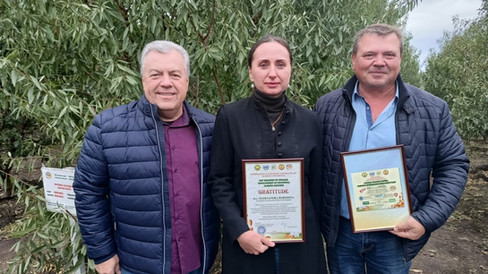
Now, before her return to Spain, Dra. Oleksandra Borodina again visited the Almond Orchards nursery and inspected the operation of the sensor, had the opportunity to get acquainted in more detail with the technological sections of the nursery, with a one-year industrial almond orchard planted with Spanish varieties.
Together with the association's chief agronomist, Oleksiy Zelenko, we investigated the presence of generative (fruit) buds that are already present on one-year-old young almond trees, and the condition of vegetative (growth) buds.
Together with Valery Burov, the head of the Almond Gardens nursery, she participated in harvesting the first harvest of Spanish almond varieties, samples of which will be transferred to Spain for further research.
A fairly thorough conversation took place regarding the further development of cooperation between specialists of the Walnut Association and the CEBAS-CSIC center, involving scientists from the Institute of Horticulture of the NAAS of Ukraine, the Institute of Climate-Oriented Agriculture of the NAAS, and the Mykolaiv National Agrarian University, with whom a Memorandum of Cooperation was signed during the International Almond Conference on September 12, 2025.
The prospects for the development of industrial almond farming in Ukraine are the newest and most popular direction in the development of the country's nut industry. The start of the creation of industrial orchards in Ukraine from self-fertile varieties of almonds of Spanish selection has already taken place - the nursery "Almond Gardens" is already accepting orders for the sale of self-fertile almond seedlings (tel. 0677708852 Burov Valeriy), the technology for creating industrial almond orchards for the regions of Ukraine has been developed (tel. 0669775465 Zelenko Oleksiy). Despite this, we continue to study in more detail modern technologies for creating industrial orchards from self-fertile varieties of almonds of Spanish selection, their cultivation and maintenance together with Spanish specialists, domestic scientists, and practicing gardeners.
President of the Ukrainian Walnut Association G. Yudin
Chief Agronomist of the Ukrainian Walnut Association O. Zelenko
October 2, 2025, Svitlovodsk, Kirovohrad region.